
Purchase-Powered Giveaways: The Complete Guide for Shopify Merchants
A purchase-powered giveaway turns every Shopify order into giveaway entries, so the campaign earns revenue instead of only spending on a prize. This guide covers how the format works end to end…
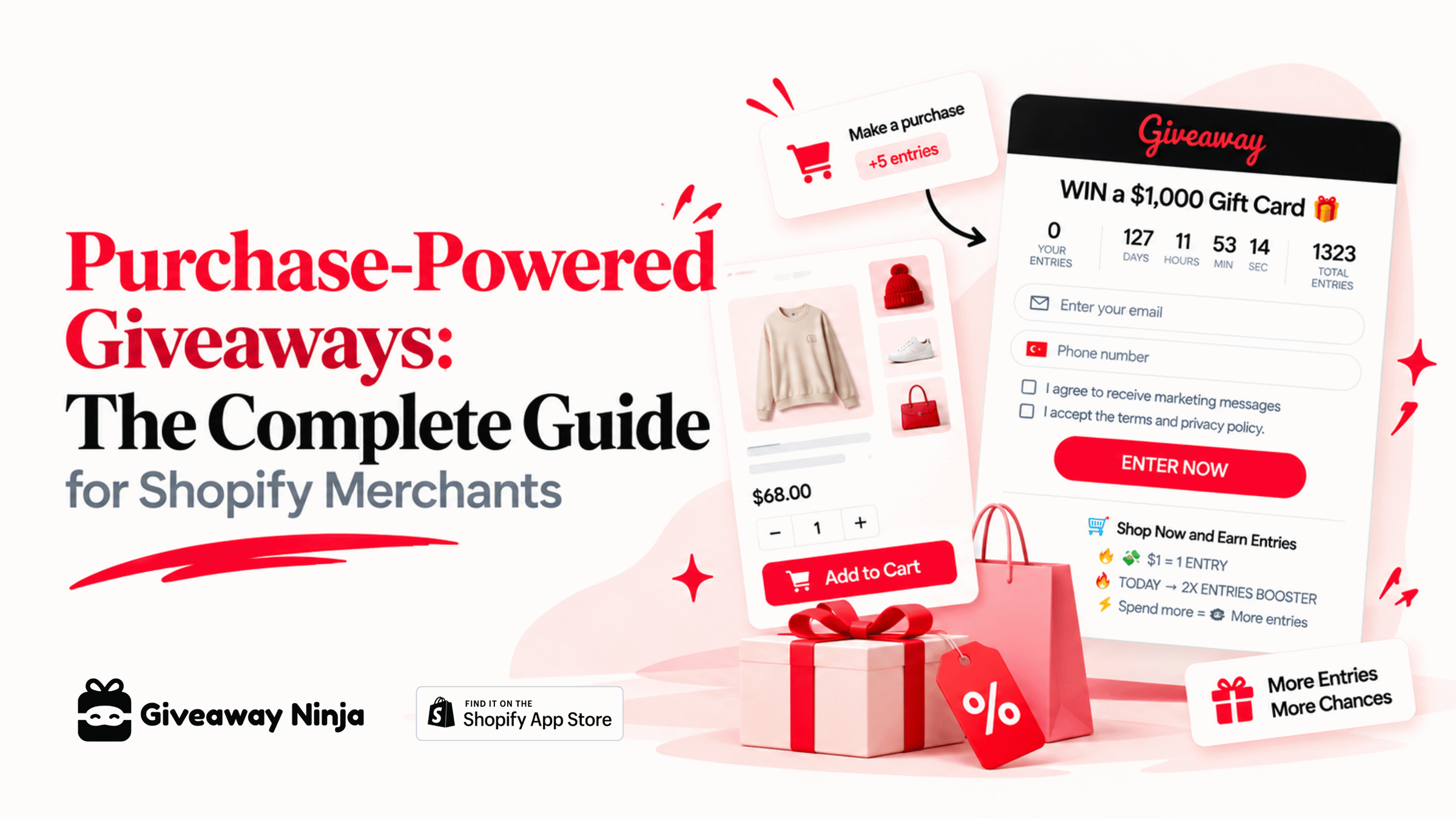
A purchase-powered giveaway turns every Shopify order into giveaway entries, so the campaign earns revenue instead of only spending on a prize. This guide covers how the format works end to end: order tracking, entry-per-dollar math, the Shopify integration, revenue attribution and the compliance rules that keep it a legal sweepstakes.
It's written for founders and ecommerce leads who already know what a giveaway is and want one that shows up in the P&L. Every mechanic below is documented in the Giveaway Ninja help center, so you can check the details as you go.
What is a purchase-powered giveaway?
A purchase-powered giveaway is a sweepstakes where purchases are the main way to earn entries, with a free entry path that keeps it legal. Entries scale with what a shopper buys, so the giveaway runs as a sales channel with a prize at the end.
Giveaway Ninja built its product around this model and uses the term to name it. The app is positioned as purchase-powered giveaways for Shopify, and the Shopify Giveaway Playbook describes the model as a loyalty program with a prize at the end.
Four traits define the category:
- Purchases carry most of the entry weight. Social actions, polls and referrals are bonus layers on top, not the main path.
- Entries come from order data. The app reads real Shopify orders, so nobody self-reports a purchase.
- Free entry is always available. Every campaign includes a no-purchase route at equal odds.
- Every order is logged. Revenue ties back to the campaign, entrant by entrant.
How it compares with other giveaway formats
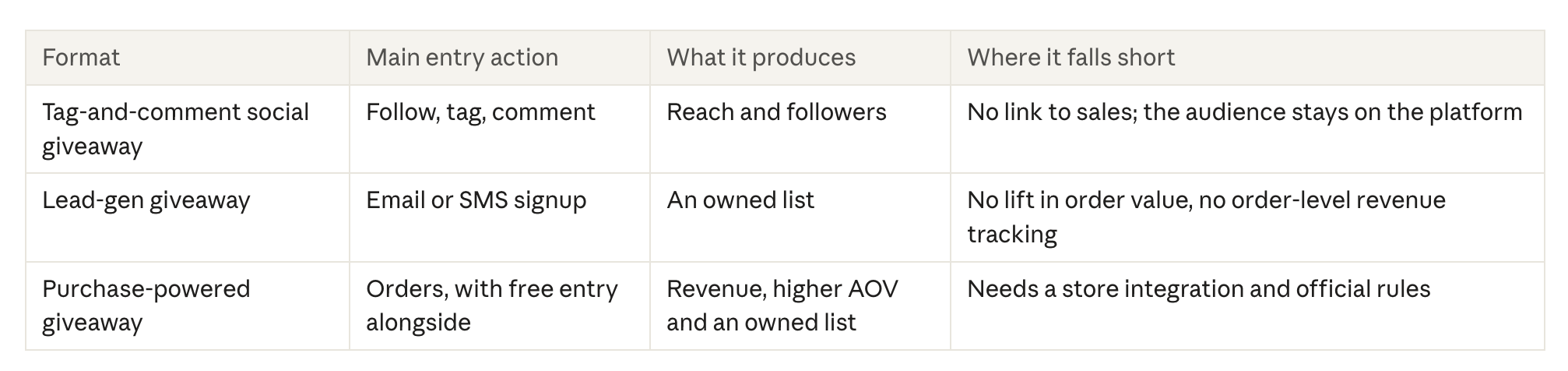
The formats work together. A social giveaway builds hype; a purchase-powered one turns that attention into orders and subscribers you keep. Most brands only run the first kind.
How purchase tracking works
Purchase tracking runs on Shopify order webhooks. When an order is created, Shopify notifies the giveaway app, which matches the buyer to an entrant and calculates entries. The full sequence is documented in how purchase-based giveaway entries work.
The order pipeline
- A shopper places an order and Shopify sends an order webhook.
- Duplicate webhooks are ignored, so one order can never award entries twice.
- The order is matched to a participant by email address, then by the entrant's unique discount code.
- With no match, Auto-Signup can create a participant from the order in the most recent active giveaway. Without it, the order is logged as "no-user" and earns nothing.
- Validation checks run on order source, order date and minimum order value.
- Entry rules run, and the final entries are added to the entrant's total and written to the order log.
Matching is where most problems start
Email is the primary match key. If someone enters with a personal address and checks out with a work address, the order won't match unless a unique code was used or Auto-Signup is on.
For campaigns where every order should earn entries, turn on Auto-Signup as described in how Giveaway Ninja tracks sales from a giveaway. Every buyer then becomes a participant automatically.
Validation decides which orders qualify
The source filter matters for brands with physical retail. Point-of-sale orders can earn entries automatically, and Rogue Meat Co. adds in-store purchases by hand in a few moments.
Edits, cancellations and refunds
The Order Created webhook is always on. Three optional webhooks keep entries accurate after checkout:
- Order edits roll back the original entries and reprocess the updated order. This covers post-purchase upsell apps that add items after checkout.
- Cancellations revoke the order's entries and write an audit record with the cancel reason.
- Refunds recalculate entries on what the customer kept. A full refund without a cancellation drops the order to zero.
Each order can only be rolled back once, which prevents double deductions. Orders placed before launch can be credited with the Import Shopify Orders tool.
Entry-per-dollar mechanics
The base layer of a purchase-powered giveaway is entries per dollar spent; every other rule adds to it or multiplies it. Giveaway Ninja evaluates rules in a fixed order, and that order changes the result.
Base entries
Three modes set the base: a fixed number per order, entries per amount spent, or no base entries at all. In per-amount mode, the formula is:
\text{Base entries} = \left\lfloor \frac{\text{Adjusted order value}}{\text{Amount per increment}}
\right\rfloor \times \text{Entries per increment}
You choose whether order value means the subtotal (products only) or the total paid (shipping and tax, after discounts). With total paid, gift card payments are deducted, so shoppers earn entries only on money they spent.
Example: 5 entries per $10 on total paid. A $150 order with $20 paid by gift card earns floor(130 ÷ 10) × 5 = 65 entries.
The layers on top
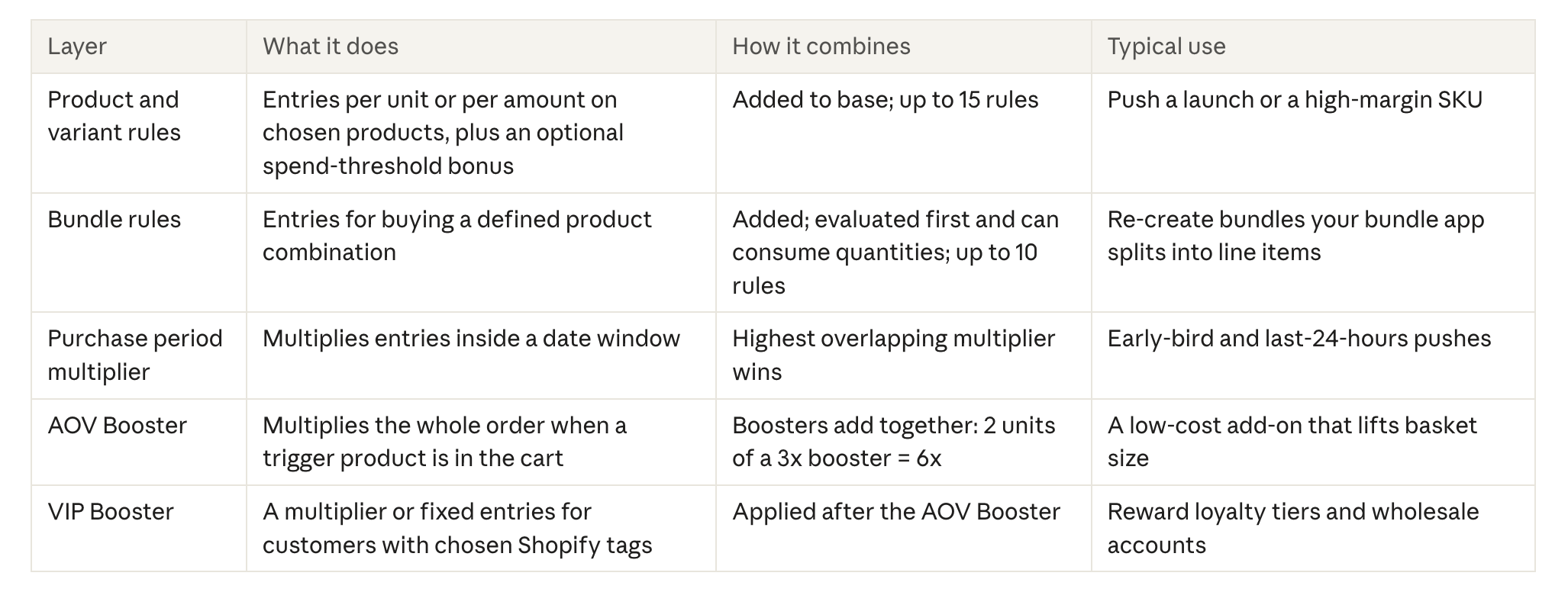
The full calculation for one order:
\text{Final entries} = (\text{Base} + \text{Bundle} + \text{Product}) \times \text{Period}
\times \text{AOV} \times \text{VIP} + \text{VIP fixed}
A worked example
Settings: 1 entry per $5 of subtotal, 200 entries per pair of limited sneakers, and a 2x Black Friday window. A shopper buys two $120 pairs and a $30 tee on Black Friday.
- Base: floor(270 ÷ 5) × 1 = 54 entries
- Product rule: 2 × 200 = 400 entries
- Subtotal 454, doubled by the date window: 908 entries
The AOV Booster
The AOV Booster is a cheap trigger product, often a $5 digital boost card, that multiplies every entry in the order. Shoppers pay a small amount for more chances to win, and almost all of it lands as margin.
Turn on "Exclude from order total" so the booster's own price doesn't also earn base entries. The AOV Booster is included on Premium and Ultimate, per Giveaway Ninja pricing.
Design rules that keep the math working
- Show the number everywhere. A visible entry count on the product page, in the cart and on the thank-you page makes the reward concrete.
- Time your multipliers. Use date windows at the open and the close, not across the whole campaign.
- Re-map your bundles. Bundle apps split bundles into separate line items, so recreate each one as a Bundle Rule.
- Avoid double rewards. Turn on "Skip if bundle matched" when a product rule targets the same items as a bundle.
The Playbook's entry multiplier stack shows how base, product, date, AOV and referral layers fit into one campaign.
Shopify integration and the API
A purchase-powered giveaway lives inside the store, not on a separate microsite. On Shopify that takes three parts: order webhooks for tracking, theme App Blocks for display, and an API for custom builds.
Where entries show up in the store
Giveaway Ninja's native App Blocks put the entry count in front of shoppers at each step:
- A giveaway widget, embedded on any page or on a dedicated landing page
- Entry badges on Shopify product pages and on collection page product cards
- A giveaway entry counter in the cart, where AOV Boosters can be recommended
- Checkout and thank-you page entry badges that confirm what the order earned
Badges estimate entries from the cart alone, so they leave out VIP Booster entries. The widget, the Entries page and the order logs show the true total.
The Giveaway Ninja API
For headless stores, custom carts or mobile apps such as Tapcart, the Giveaway Ninja API documentation covers two layers. Every call goes to https://api.giveaway.ninja.
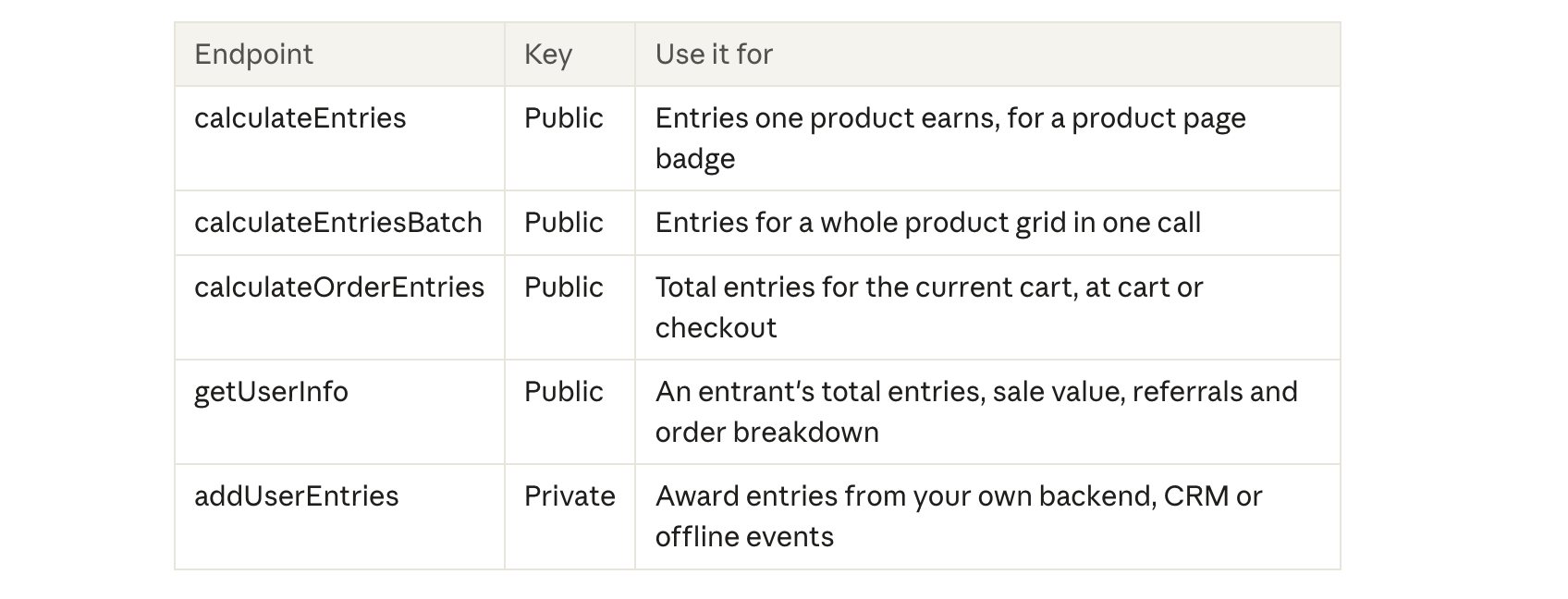
Public calls check the request origin against an allowed-origins list and are limited to 15 requests per minute per IP. Add extensions.shopifycdn.com to that list to call the API from Shopify checkout extensions.
The private key stays on your server. Use addUserEntries for purchases Shopify never sees, such as event sales or orders from a separate wholesale system.
Klaviyo and lifecycle email
Each processed order can fire a Klaviyo event, named "Giveaway Ninja Order Entries" by default. Use it to email customers when they earn giveaway entries or to nudge them toward the next spend threshold.
Poll answers and entry behavior can become Klaviyo segments for the next campaign. Setup steps are in the Giveaway Ninja Klaviyo integration guide.
Revenue attribution
A purchase-powered giveaway can be measured like a paid channel, because every entry traces back to an order. Giveaway Ninja attributes each Shopify order to exactly one giveaway, so revenue is never counted twice across campaigns.
How an order gets attributed
The app lists every active giveaway, matches the order email or discount code to a participant, and credits the first match. With no match, the order goes to the most recent active giveaway with Auto-Signup turned on.
Each entrant record carries a sale value: the total revenue attributed to that person. The order log shows the rule-by-rule calculation for every order, including the ones that earned nothing and the reason why.
Attributed is not the same as incremental
Attributed revenue is what entrants spent during the campaign. Some of those shoppers would have bought anyway, so it overstates the lift.
To estimate the real effect, compare against a baseline: the prior month, the same period last year, or a customer segment that never saw the giveaway. Report both numbers so nobody reads attributed sales as net-new sales.
The metrics that matter
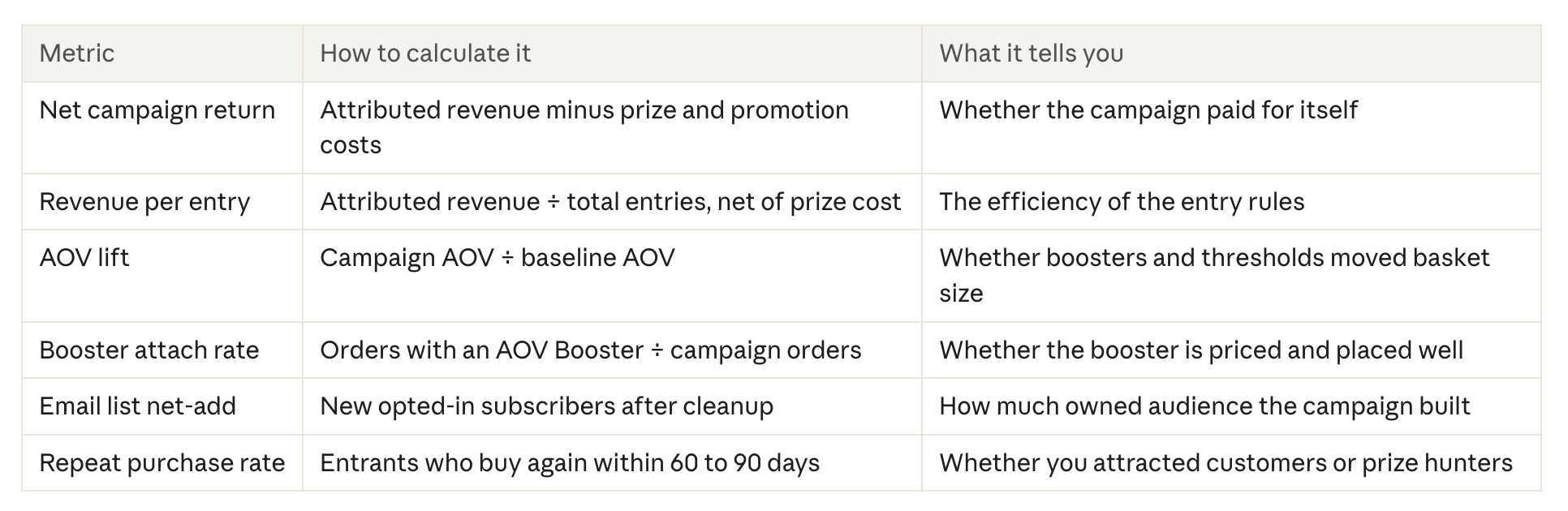
The Playbook's guide to vanity vs real giveaway metrics ranks revenue per entry as the single most important number.
What the format produces at scale
Across a sample of 29 brands in 25 verticals, the Playbook's case study data reports more than $32M in tracked sales. The founder's note in the Playbook cites merchants closing over $3M a month through the app.
For single-brand results, read how Poke-Collect runs an always-on purchase giveaway or browse all Shopify giveaway case studies.
Compliance: keeping it a sweepstakes
A promotion that combines a prize, chance and a required purchase is a lottery, which private businesses can't run in the US and most other markets. Purchase-powered giveaways stay legal by offering a free alternate method of entry (AMOE) in every campaign. This section summarizes the rules; it is not legal advice.
Important: check the law where you and your entrants are based. Sweepstakes rules differ by country, state and province, and they change. The summaries below are a starting point, not a complete or current statement of the law. Before launch, confirm the requirements in every market your giveaway is open to, and talk to a promotions lawyer for high-value prizes or cross-border campaigns.
The AMOE test
The free entry path must be:
- Conspicuous, not buried in fine print
- At least as easy as the paid path, with no extra hoops
- Pooled with paid entries at identical odds of winning
Most Shopify brands use an online free-entry form. Giveaway Ninja's Sign-up Bonus Entry action awards an entry the moment someone submits the form, as explained in the no-purchase-necessary rules in plain English.
How many entries the free path earns relative to a large order is the question most worth taking to a promotions lawyer. Settle it before launch, and state it in your Official Rules.
United States
Federal law bars lottery promotions under 18 U.S.C. § 1302. Three states add filings before launch:
Requirements for:
- New York - Total prize value over $5,000 - Register 30 days before launch and post a bond (NY GBL § 369-e)
- Florida - Total prize value over $5,000 - Register 7 days before launch and post a bond or trust (Fla. Stat. § 849.094)
- Rhode Island - Retail promotions over $500 - File with the Secretary of State (RI filing instructions)
Official Rules must name the sponsor, eligibility, start and end dates, prize value, odds, AMOE instructions and winner selection method. The free giveaway rules generator drafts a first version in about a minute.
Canada, the UK, the EU and Australia
Requirements for:
- Canada - The winner answers a skill-testing question; prizes, odds and dates are disclosed - Criminal Code s. 206, Competition Act s. 74.06
- Quebec - Contest registration ended October 27, 2023; rules and ads must be available in French - Playbook compliance chapter
- United Kingdom - Free route no more expensive, no less convenient and equally likely to win, promoted with equal prominence - Gambling Act 2005, Schedule 2, CAP Code Section 8
- European Union - Marketing consent on a separate, unticked box; entry can't depend on consent - GDPR
- Australia - Permits in NSW (over A$10,000), SA (over A$5,000), ACT (over A$3,000) and NT (over A$5,000) - NSW trade promotions and state regulators
Fair draws and clean entries
Run a test draw first, then the live draw against the full entry pool, with paid and free entries at identical odds. Keep the record: timestamp, pool size, free entries included and the selection method, as covered in how to draw and notify giveaway winners.
Referral mechanics attract fake accounts. Turn on reCAPTCHA and email validation, and remove bots and fake entries from your giveaway before the draw.
Launch checklist
- Prize chosen: your own product or a brand experience, not cash or an iPhone
- Base entries set, with the subtotal or total-paid choice made on purpose
- At least two extra layers configured: a product rule, a date window or an AOV Booster
- Free entry action live, equally easy and pooled at equal odds
- Official Rules published and any state or country filings submitted
- Edit, cancellation and refund webhooks turned on
- Entry badges on product pages, cart and thank-you page
- Klaviyo event connected and entrants tagged by campaign
- Baseline AOV and revenue recorded for comparison
- Non-winner follow-up email scheduled within 24 hours of the draw
For a step-by-step setup, start with how to set up a giveaway on Shopify.
Frequently asked questions
Is a purchase-powered giveaway legal?
Yes, when a free entry path exists with equal odds and the Official Rules are published. Without free entry, a purchase-only giveaway becomes an illegal lottery in the US and most other markets. Before launch, confirm the requirements in every market your giveaway is open to.
Does it work outside Shopify?
Purchase entries work on Shopify and Wix. On a custom website, you can collect entries through email, social actions and referrals; see the giveaway platforms Giveaway Ninja supports.
How long should a campaign run?
The Playbook recommends 14 to 21 days for a standalone campaign and 30 days for a monthly always-on rhythm. Shorter campaigns leave no room for the email sequence; longer ones cause deadline fatigue.
What should the prize be?
Pick something only your customers would want, usually your own product. A branded prize filters out professional entrants and turns non-winners into buyers.
How is this different from a discount?
A discount lowers the price a shopper expects to pay. A purchase-powered giveaway keeps full price, adds a reason to spend more, and builds a list you own.
Start your first purchase-powered giveaway
Install the Giveaway Ninja app for Shopify and launch with base entries, one product rule and free entry. To plan the mechanics for your category, book a giveaway strategy call.